American Pickers’ Star Unveils Rare Find In Latest Post: ‘Outlaw’ Bicycles, Rare Elgin Bluebird & Gas-Station Gold

What to Know
- Mike Wolfe and Jersey Jon Szalay travel to the Houston area to sort a late collector’s bicycle-filled garage — described by the family as “Bicycle Mania.”
- Mike buys a group of 1930s–1940s bicycles (including a Schwinn B10E), negotiates for a partial Elgin Bluebird, and estimates potential restoration value in the tens of thousands.
- Meanwhile Robbie Wolfe returns to a previous picker’s property and secures vintage gas-station signs and accessories, including a high-profile Frontier Gasoline sign.
American Pickers’ latest episode delivers a surprising mix of art, nostalgia and big-ticket restorations — Mike Wolfe stumbles into a Texas garage dubbed “Bicycle Mania,” where outlaws’ names are painted on one-of-a-kind bikes and a scattered Elgin Bluebird could be worth a small fortune once rebuilt.
Danielle Colby sent Mike Wolfe and Jersey Jon Szalay to Texas for the March 29 episode of History Channel’s American Pickers. Outside Houston they met Erline and Jesse Outlaw Jr., caretakers of a collection assembled by the late Jesse Outlaw Sr., a window-treatments businessman who treated found objects as canvases — turning vacuums into robot sculptures and treating bicycles as industrial art. Jesse Sr. died four years earlier; the family had spent time sorting his belongings and decided to part with some pieces so others could enjoy them.
“Bicycle Mania” and the Outlaw Collection
The garage was described by the family as “Bicycle Mania,” with bicycles from floor to rafters. Mike focused on several notable machines: a motorbike built on a Hawthorne frame with a lawn-mower engine and an Outlaw insignia; a group of restored 1930s–1940s bicycles, including a Schwinn B10E — one of the early models to feature balloon tires and a small storage box behind the seat used to carry everything from tools to comic books; and a Marsh-Metz frame, an important early American brand.
Negotiations produced a mid-range deal: Mike paid $1,800 for three unique bicycles after some back-and-forth. When Jon and Mike reconstructed the parts search — finding compatible motors and components — Jon estimated one of the projects could take up to six months of restoration work. In good condition similar bikes can command $32,000–$35,000, but the condition here required additional investment; Jon offered $10,000 all-in for the larger group and Erline agreed, wanting her husband’s vision preserved.
The Elgin Bluebird: A Mount Rushmore Candidate
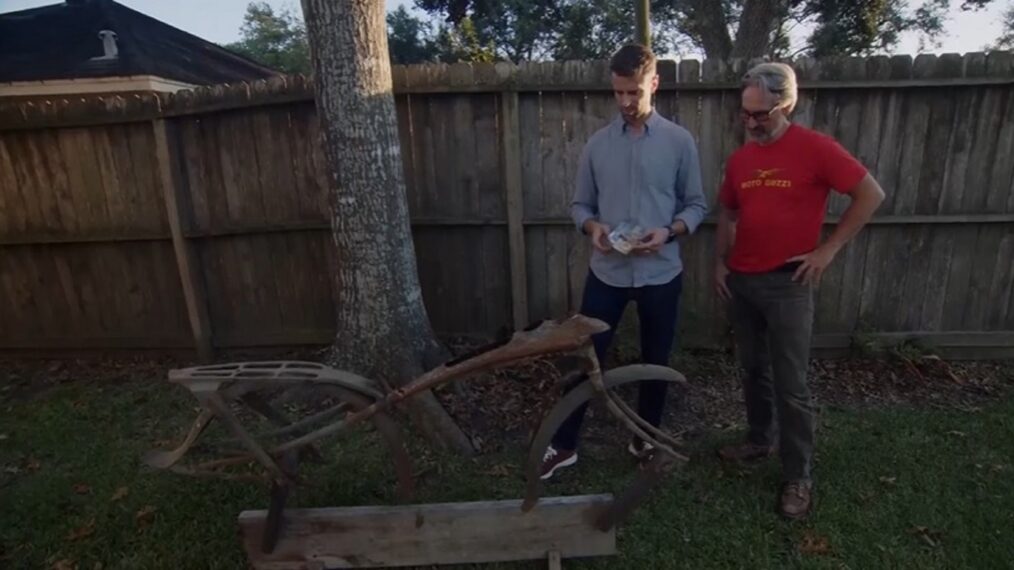
The crew also found remnants of an Elgin Bluebird, the most coveted model of the mid-1930s. Prized in its day — it cost roughly $45 in 1935–1937, equal to several weeks’ wages for many workers — the Bluebird remains a museum-quality collectible. Mike called the model worthy of a spot on the “Mount Rushmore of antique bicycles.”



Jesse Jr. produced extra parts and a photograph of his brother with the bike, but the find needed significant restoration. Mike’s starting offer was $3,000; Jesse Jr. hoped for $4,500. The pickers compromised near $3,200, acknowledging the value of the pieces while factoring in the cost to restore the Bluebird to complete condition. Before leaving, Mike and the family arranged to display some of Jesse Sr.’s robot sculptures alongside other artwork to celebrate his creative legacy.
Robbie Wolfe Returns to a Former Pick
On a separate road, Robbie Wolfe visited Byron, a collector Mike and the late Frank Fritz had picked about a decade earlier. Byron’s collection had since expanded — he says it doubled as he bought from multiple collectors — and he operates an antique store out of a converted schoolhouse run by his daughter on weekends. Robbie purchased a large sign for $1,000 and some tank covers for $400, plus a Chevrolet dealership radio and other relics.
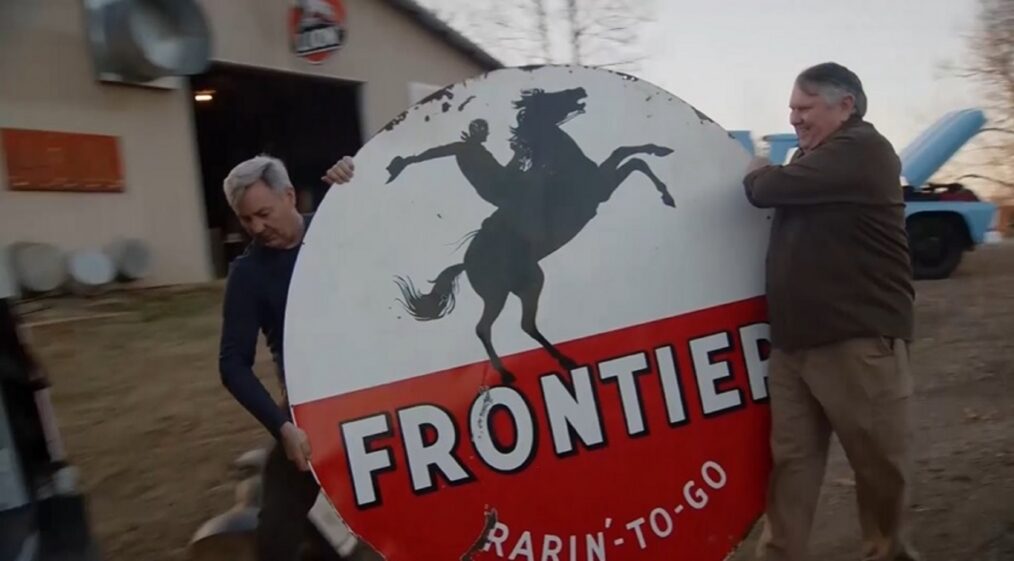
Byron showed Robbie a Frontier Gasoline sign he prized. Asking $14,000, he eventually accepted $12,500 after negotiation — a reminder that the sentimental value of these pieces often tracks alongside market demand and family stories. Byron also pointed out a 1973 Shortbox truck he bought for a son who later died; it now sits as a memorial and potential heirloom for the next generation.
Across both pickups — the Texas bicycle trove and Byron’s gas-station ephemera — the episode underlines two persistent themes of American Pickers: the economic value of restored pieces and the emotional value of objects tied to family histories and local memory.